
Key takeaways
- A DCR panel is made with solar cells manufactured in India. A non-DCR panel uses imported cells, even if it is assembled here.
- Only DCR panels qualify for the PM Surya Ghar subsidy, PM-KUSUM and other schemes that require Indian content.
- DCR panels cost about ₹6 to ₹8 more per watt at retail but are not more efficient. You pay the premium for the subsidy, not for extra output.
- Check any DCR panel yourself on the government’s DCR Verification Portal using the certificate number or the panel’s serial number.
DCR stands for Domestic Content Requirement. A DCR solar panel uses cells made in India, with every step from the silicon wafer to the finished cell done here, and is registered with a certificate on the government’s DCR Verification Portal. A non-DCR panel uses imported cells. Both can be BIS-certified and on the approved module list, but only DCR panels qualify for the PM Surya Ghar subsidy.
DCR vs non-DCR at a glance
| DCR panel | Non-DCR panel | |
|---|---|---|
| Solar cells | Made in India, from wafer to cell | Imported, even if the panel is assembled in India |
| PM Surya Ghar subsidy | Yes, the only panels that qualify | No |
| Retail price, October 2026 | ₹24–34 per watt | ₹18–26 per watt |
| Efficiency | 20.5–23% depending on cell type | 20.5–24%, about the same |
| Proof | 16-digit DCR certificate, checkable online | Datasheet and ALMM listing only |
| Availability | Waits of 3 to 4 weeks reported since June 2026 | Readily available |
What counts as a DCR panel
Assembling a panel in India is not enough. Since March 2025 the cells must be made from undiffused wafers, with diffusion and every later step done in India. Cells made from imported, already processed wafers do not count. The panel maker registers each batch of cells and panels on the DCR Verification Portal, run by the National Institute of Solar Energy under MNRE, and every panel gets a traceable serial number.
When a vendor sells DCR panels to a home under PM Surya Ghar, they generate a B2C DCR certificate in your name. It carries a 16-digit number in the format XXXX-XXXX-XXXXXXXX and lists the serial number and wattage of each panel, the invoice number and date, and your details. The national portal reads the panel serial numbers straight from this certificate, and the DISCOM checks them at inspection.
Is a DCR panel better than a non-DCR panel?
No. DCR and non-DCR panels use the same cell technologies, Mono PERC and TOPCon, and lose output in heat at the same rate. Indian-made cells have tended to be slightly less efficient than the best imported cells, by around half to one and a half percentage points at the cell level, so a DCR TOPCon panel is typically 21.5 to 23% efficient against 22 to 24% for imported TOPCon. On a home roof that difference is too small to notice on your bill.
So judge a DCR panel the way you would any panel: wattage, cell type, product warranty and the maker’s service record. The panel comparison lists DCR status alongside the specifications.
The price difference, and when it pays
India can make far more panels than cells. By June 2026 the country had about 262 GW of panel capacity but only about 37 GW of cell capacity, so DCR panels are scarce and expensive. At the factory gate the gap is about ₹8 to ₹11 per watt; in shops it works out to roughly ₹6 to ₹8 per watt once both kinds carry GST and dealer margins. When the cell rule for most projects tightened on 1 June 2026, DCR panel prices jumped by about a fifth and buyers reported waits of 25 to 30 days.
| 3 kW home system | With DCR panels | With non-DCR panels |
|---|---|---|
| Extra panel cost | about ₹20,000–26,000 more | base |
| PM Surya Ghar subsidy | ₹78,000 | ₹0 |
| Net effect | about ₹52,000–58,000 cheaper |
For any home claiming the subsidy, DCR panels are the cheaper choice by a wide margin. Non-DCR panels only make sense when you are not claiming the subsidy at all. See current per-watt prices in solar panel price in India.
Which panels you are allowed to use
- Home system with the PM Surya Ghar subsidy: DCR panels only, verified on the DCR portal.
- Home system on the PM Surya Ghar portal with “Give It Up” chosen: non-DCR panels allowed. Such applications are exempt from the cell rule until 31 March 2027.
- Net-metered system without any subsidy: non-DCR panels allowed if the system is commissioned by 31 December 2026. After that, the cells must come from makers on ALMM List-II.
- Off-grid system with no net meter: the approved lists do not apply. Any BIS-certified panel can be used.
- PM-KUSUM solar pumps and other government schemes: DCR panels, as the scheme guidelines require.
How to check if a panel is really DCR
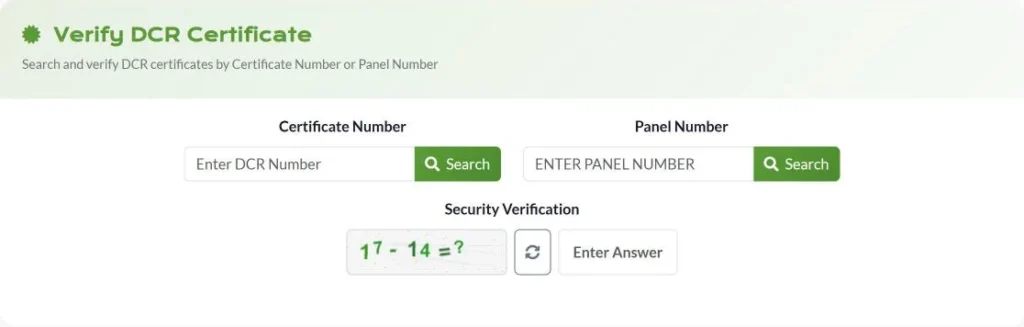
The DCR Verification Portal has a public search that anyone can use without logging in. You can check either the certificate or a single panel.

- Open the DCR Verification Portal and click Verify DCR Certificate / Module in the top menu.
- To check your certificate, enter the 16-digit number under Certificate Number. To check one panel, type the serial number from the label on the back of the panel under Panel Number.
- Answer the small sum under Security Verification and click Search.
- Match the result against what you were given: the panel maker, wattage and serial numbers should be the same as on your invoice and on the panels on your roof.
Do this before the vendor submits the installation details on the PM Surya Ghar portal. If a serial number does not show up, or shows a different wattage or maker, stop and ask the vendor in writing. It is far easier to swap panels before inspection than to fight a rejected claim afterwards.
Warning signs
- A quote noticeably cheaper than others for “DCR” panels with no certificate number offered.
- The same serial number on more than one panel, or serial labels that look stuck on. Since 26 May 2026 the portal rejects applications with a repeated serial number.
- A certificate in the vendor’s name or a B2B certificate instead of a B2C certificate in yours.
- Panels whose serial numbers do not appear on the portal at all.
Applying for the subsidy? The step-by-step application guide shows where the DCR certificate fits in, and the PM Surya Ghar subsidy guide covers how much you get.
Frequently asked questions
What is the full form of DCR in solar?
DCR stands for Domestic Content Requirement. A DCR solar panel is made with solar cells manufactured in India. NDCR or non-DCR means the panel uses imported cells.
What is the difference between DCR and non-DCR solar panels?
DCR panels use Indian-made cells and qualify for the PM Surya Ghar subsidy. Non-DCR panels use imported cells, cost about ₹6 to ₹8 less per watt at retail and do not qualify for the subsidy. Their efficiency is about the same.
Is a DCR panel mandatory for PM Surya Ghar?
Yes. Only DCR panels verified on the DCR portal qualify for the subsidy. A system with non-DCR panels can only be installed under the Give It Up option, without any subsidy.
How do I check whether my solar panel is DCR?
Go to the DCR Verification Portal, click Verify DCR Certificate / Module, and search with your 16-digit certificate number or the serial number on the back of the panel.
Are DCR panels more efficient?
No. They use the same PERC and TOPCon technologies. Indian cells have been slightly less efficient than the best imported cells, but the difference is too small to notice on a home system.
Why are DCR panels more expensive?
India makes far fewer solar cells than panels, about 37 GW against 262 GW of capacity in mid-2026, so DCR panels are in short supply.