
Key takeaways
- Size an inverter for home from the load you want during a cut: add the watts, divide by 0.8 for VA, then leave about 25% headroom.
- A 2BHK running fans, lights, TV, Wi-Fi and a fridge needs about 900 VA to 1 kVA. Add a cooler and a laptop and you need about 1.5 kVA on 24 V.
- A 150 Ah battery gives about 3 hours at 250 to 300 W if you use only half of it, which is what keeps a lead-acid battery healthy.
- A 900 VA sine wave inverter with a 150 Ah tubular battery costs about ₹16,000 to ₹22,500; Luminous listed its combos at ₹18,898 to ₹21,198 in November 2026.
Buying an inverter for home comes down to two numbers: the VA rating of the inverter, which decides how many appliances can run together, and the Ah rating of the battery, which decides how long they run. Shops often push a bigger combo than you need, and model names make it harder: a Luminous Zelio 1100 or Power Sine 1100 is a 900 VA inverter, not 1,100 VA. This guide shows how to work out both numbers for your home, what a sensible setup costs in 2026, and which battery type suits your power cuts.
This is about the home inverter, also called a home UPS or power inverter for home, that charges a battery from the grid. If you want panels on the roof as well, read our solar inverter guide first.
Step 1: list what your inverter for home must run
Start with the appliances you actually need when the power goes, not everything in the house. Typical running watts:
| Appliance | Typical watts | Notes |
|---|---|---|
| LED bulb | 9 W | Tube lights about 20 W |
| Ceiling fan, normal | 70 to 75 W | A BLDC fan uses 28 to 35 W |
| LED TV, 32 to 43 inch | 50 to 100 W | |
| Wi-Fi router | 10 W | |
| Laptop | 50 to 65 W | Desktop with monitor 150 to 200 W |
| Refrigerator | 100 to 250 W running | Needs 3 to 4 times that for a moment when the compressor starts |
| Air cooler | 150 to 200 W | |
| 1.5 ton AC | 1,300 to 1,500 W | Not practical on a normal home inverter |
Add up what you want to run together. The home load calculator does this for you.
Step 2: turn watts into the inverter VA rating
Inverters are sold in VA, not watts. Divide your total watts by 0.8 to get VA, then add about 25% so the inverter is not running flat out and can handle the start-up surge of a fridge or cooler motor.
| Home and load during a cut | Watts | VA needed | Inverter for home to buy |
|---|---|---|---|
| 1BHK: 2 fans, 4 LED bulbs, TV, Wi-Fi | 256 W | About 400 VA | 600 to 700 VA, 12 V |
| 2BHK: 3 fans, 6 LED bulbs, TV, Wi-Fi, fridge | 499 W | About 780 VA | 900 VA to 1 kVA, 12 V, sine wave |
| 3BHK: 4 fans, 8 LED bulbs, TV, Wi-Fi, fridge, cooler, laptop | 832 W | About 1,300 VA | 1.5 kVA, 24 V, two batteries |
| Same 3BHK with BLDC fans | 652 W | About 1,020 VA | 1 to 1.1 kVA may be enough |
That last row is worth noticing. Swapping ordinary fans for BLDC fans can drop you one inverter size and one battery. Our BLDC fan guide has the numbers.
Running an AC on an inverter is a different job: a 1.5 ton AC needs about 3 to 5 kVA and a large battery bank, and whole-home backup with two ACs goes up to 7.5 or 10 kVA on 48 V or more. At that size, a rooftop solar system with a battery usually costs about the same and also cuts your bill. For a full size-by-size breakdown, see what a 500 W, 1 kVA or 2 kVA inverter can run.
Step 3: choose the battery for the backup time you need
Battery size decides hours, not appliances. A 12 V, 150 Ah battery stores about 1,800 Wh. You should not plan to use all of it: draining a lead-acid battery fully, day after day, shortens its life. Plan on using about half, and assume the inverter loses about 15% converting it.
| Load during the cut | 150 Ah, 12 V | 200 Ah, 12 V | 2 × 150 Ah, 24 V | 150 Ah, occasional deep use (70%) | 150 Ah drained fully |
|---|---|---|---|---|---|
| 200 W | 3.8 | 5.1 | 7.7 | 5.4 | 7.7 |
| 300 W | 2.5 | 3.4 | 5.1 | 3.6 | 5.1 |
| 400 W | 1.9 | 2.5 | 3.8 | 2.7 | 3.8 |
| 500 W | 1.5 | 2.0 | 3.1 | 2.1 | 3.1 |
| 700 W | 1.1 | 1.5 | 2.2 | 1.5 | 2.2 |
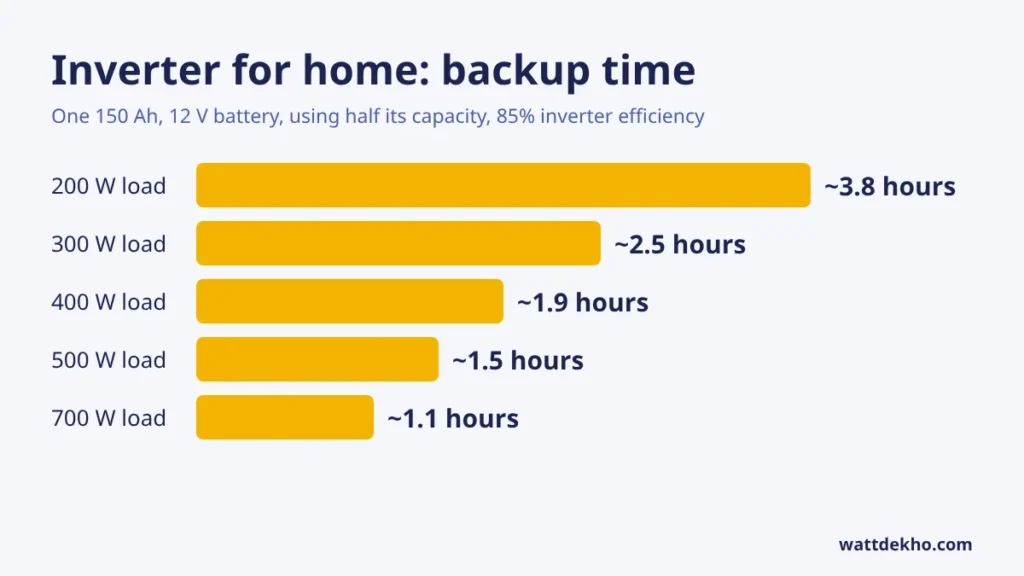
If your cuts usually last two to three hours and your load is around 300 W, one 150 Ah battery is right. For four hours or more, go to 200 Ah or a 24 V setup with two batteries. Try your own load in the inverter backup calculator.
Which inverter battery type to pick
| Battery type | Typical life | Warranty seen | Price (2026) | Best for |
|---|---|---|---|---|
| Flat plate, 150 Ah | 2 to 4 years | Shortest of the three; check the box | ₹11,499 to ₹11,999 | Short cuts, tight budget |
| Tubular / tall tubular, 150 Ah | 4 to 6 years | 36 to 75 months | ₹12,799 to ₹16,499 (median ₹14,299) | Most homes, long daily cuts |
| Lithium (LiFePO4), 12.8 V 100 Ah | Up to 3,000 cycles (maker claim) | 60 months | ₹23,999 | No maintenance, deep daily use |
For most Indian homes a tall tubular battery is the default. Its warranty is the number to compare: the Luminous Lifemax LM 18075, for example, carries 60 months free replacement plus 15 months pro-rata, while many 150 Ah batteries carry 36 or 48 months. Read the split between free replacement and pro-rata before you compare prices.
Lithium costs more upfront but needs no water and can be used much deeper; most makers allow 80% or more. A 100 Ah lithium battery can therefore give about as much usable backup as a 150 Ah tubular battery that you only take to half. Check that your inverter has a lithium charging mode before you switch.
Pure sine wave or square wave inverter for home?
Buy pure sine wave. It gives the same smooth power as the grid, so fans run without humming, the fridge compressor and motors run cooler, and laptops, TVs and routers are safe. Square wave models are only slightly cheaper: in August 2026 an Exide 1,125 VA square wave inverter sold for ₹5,834, while 900 to 1,000 VA sine wave models from Livguard, Luminous and V-Guard sold for ₹5,314 to ₹6,999.
Inverter for home price in 2026
Prices from the Luminous and V-Guard stores (checked 21 November 2026) and from 38 Amazon listings compiled by Zoutons on 29 August 2026:
| What you buy | Price range | Example |
|---|---|---|
| 700 VA sine wave inverter | ₹4,149 to ₹4,949 | Livguard Sineverter Pro 700, Luminous Power Sine 800 |
| 900 to 1,000 VA sine wave inverter | ₹5,314 to ₹8,299 | Livguard 900, V-Guard Prime 1150, V-Guard Smart Pro 1200s Solar |
| 1,650 VA sine wave inverter | ₹7,849 | Microtek vTURBO 2000 |
| 24 V heavy-duty sine wave UPS | ₹11,989 | Microtek Heavy Duty 2350 |
| 150 Ah tubular battery | ₹12,799 to ₹16,499 | Median ₹14,299 across 17 battery listings |
| Inverter + battery combo (Amazon, Aug 2026) | ₹16,299 to ₹22,499 for 700 to 900 VA | Median ₹18,815 across 11 combos |
| Luminous 900 VA sine wave + 150 Ah tubular (store, Nov 2026) | ₹18,898 to ₹21,198 | Power Sine 1100 + RC 18000ST; Eco Volt Neo 1050 + RC 18000 |
| Luminous 900 VA + 150 Ah, 75-month battery (store, Nov 2026) | ₹31,898 | Icon 1100 + Lifemax LM 18075 |
| Inverter + 100 Ah lithium combo | ₹25,999 | Microtek Energy Saver 1225 with LiFe battery |
A combo is usually the cheapest route for a first setup. If you already have a battery under two years old, buy only the inverter and check its charging supports your battery type. For brand-by-brand warranty and service comparisons, see the best inverter company in India.
Does an inverter for home increase your electricity bill?
A little, yes. You pay for two kinds of loss. First, the inverter draws power even with no load: Bijli Bachao measured about 7 W, which is roughly 5 units a month if it stays on all day. Second, energy is lost each time the battery charges and then feeds the inverter, so the grid supplies more units than your appliances use during a cut.
| Situation | Extra units a month | Extra cost at ₹7 a unit |
|---|---|---|
| No cuts, inverter on standby | About 4 to 5 | About ₹30 |
| 500 VA setup, 150 Ah, a 3¼ hour cut daily (Bijli Bachao worked example) | About 8.5 | About ₹60 |
| 300 W load, a 3 hour cut daily, plus standby (our estimate) | About 17 | About ₹120 |
So the inverter itself adds roughly ₹30 to ₹130 a month, depending on how often you lose power. The bigger lever is the load: BLDC fans and LED lights cut both the backup you need and these losses. Use the electricity units calculator to see what your appliances add up to.
Installing an inverter for home safely
- Keep the battery on a trolley in a ventilated spot, away from the kitchen and bedroom.
- Have an electrician wire selected circuits to the inverter, not the whole house.
- Keep geysers, irons, heaters, pumps and ACs off the inverter circuit.
- Top up tubular batteries with distilled water only, when the float indicator shows low.
- Leave the inverter switched on so the battery stays charged between cuts.
Inverter for home or solar with battery?
If cuts are long and your bill is high, a solar-compatible inverter or a full rooftop system can do both jobs. The battery charges from the sun during the day and the panels cut your bill the rest of the time. Compare the numbers in the solar calculator and our solar battery guide before you spend ₹20,000 on a grid-only setup.
Inverter for home: frequently asked questions
Which inverter is best for home use?
For most 2BHK homes, a 900 VA to 1 kVA pure sine wave inverter with a 150 Ah tall tubular battery. Bigger homes with a cooler or desktop need about 1.5 kVA on 24 V with two batteries.
How do I calculate the inverter size for my home?
Add the watts of everything you want to run during a cut, divide by 0.8 to get VA, and add about 25% headroom. A 500 W load needs an inverter of about 800 VA, so buy 900 VA to 1 kVA.
How long will a 150 Ah battery run on an inverter?
About 3 hours at 250 W, 2.5 hours at 300 W and 1.5 hours at 500 W if you use half the battery, which keeps it healthy. Draining it fully roughly doubles those hours but shortens battery life.
What can a 1 kVA inverter run?
A 1 kVA inverter handles about 600 to 800 W: for example 3 to 4 fans, 6 to 8 LED bulbs, a TV, Wi-Fi and a fridge together. It cannot run an AC, geyser, iron or water pump.
Is a power inverter for home bad for the electricity bill?
It adds a little: about 4 to 5 units a month on standby, and roughly 8 to 17 units a month in homes with a daily 3 hour cut. That is about ₹30 to ₹130 a month at ₹7 a unit.
Can a home inverter run a fridge?
Yes, a pure sine wave inverter of 900 VA or more can run a normal fridge, because it can handle the compressor start-up surge. Square wave and small 600 VA units struggle.
Can I run an AC on a home inverter?
Not on a normal 1 or 1.5 kVA home inverter. A 1.5 ton AC needs about 3 to 5 kVA and a large battery bank. Rooftop solar with a battery is usually the better route.
What is the price of an inverter with battery for home?
A 700 to 900 VA sine wave inverter with a 150 Ah tubular battery costs about ₹16,000 to ₹22,500. Luminous listed its 900 VA combos at ₹18,898 to ₹21,198 in November 2026, and a combo with a 75-month battery at ₹31,898.