
Key takeaways
- A 1000 watt inverter and a 1 kVA inverter are not the same. 1 kVA gives about 800 W; a true 1000 W inverter is about 1,250 VA.
- Plan to load any inverter to about 75% of its watts. That leaves room for the start-up surge of a fridge or cooler.
- A 900 VA to 1 kVA inverter runs a 2BHK with fans, lights, TV and fridge. An AC needs 3 kVA or more and a 48 V battery bank.
- Bigger inverters drain batteries faster: a 5 kVA unit running two ACs on four 150 Ah batteries lasts about an hour.
A 1000 watt inverter, a 1 kVA inverter and a “1100” model sound like the same thing in a shop, but they deliver different power. This guide lists what each common inverter size can actually run, from small 150 to 500 W power inverters to 2 kVA, 5 kVA and 10 kVA home units, with the battery each needs, backup hours and 2026 prices.
If you have not worked out your load yet, start with our inverter for home buying guide, which walks through sizing step by step.
Inverter size in VA vs watts: why a 1 kVA is not a 1000 watt inverter
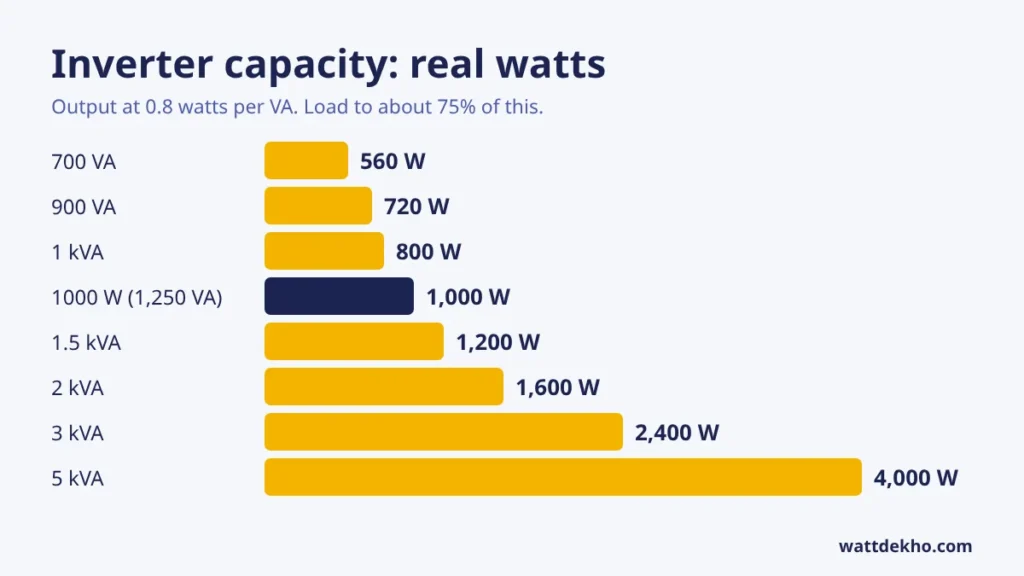
Home inverters are rated in VA. The power your appliances can actually draw, in watts, is about 0.8 times the VA. Bajaj Finserv’s 5 kVA listing shows the same ratio: 4,500 to 5,500 VA units give 3,600 to 4,400 W of output.
| Label on the box | Real output | Comfortable continuous load (75%) |
|---|---|---|
| 600 to 700 VA | About 480 to 560 W | About 390 W |
| 900 VA (sold as “1100” by some brands) | About 720 W | About 540 W |
| 1 kVA (1,000 VA) | About 800 W | About 600 W |
| 1000 watt inverter (about 1,250 VA) | About 1,000 W | About 750 W |
| 1.5 kVA | About 1,200 W | About 900 W |
| 2 kVA (2000 VA) | About 1,600 W | About 1,200 W |
| 3 kVA | About 2,400 W | About 1,800 W |
| 5 kVA | About 4,000 W | About 3,000 W |
Model names add to the confusion. A Luminous Zelio 1100 or Power Sine 1100 is a 900 VA inverter, and a Microtek Heavy Duty 1550 is 1,250 VA. Always read the VA on the spec sheet, not the number in the name.
What each inverter size can run
| Inverter size | Battery setup | What it runs well | Do not run | Backup on 150 Ah batteries* |
|---|---|---|---|---|
| 500 W (600 to 700 VA) | 12 V, 1 battery | 2 to 3 fans, 4 LED bulbs, TV, Wi-Fi | Fridge, cooler, AC | About 2.5 h at 300 W |
| 900 VA to 1 kVA | 12 V, 1 battery | 3 to 4 fans, 6 to 8 bulbs, TV, Wi-Fi, fridge | AC, iron, geyser, pump | About 1.5 h at 500 W |
| 1000 watt (about 1,250 VA) | 12 V, 1 battery | All of the above plus a cooler or laptop | AC, geyser | About 1.2 h at 650 W |
| 1.5 kVA | 24 V, 2 batteries | 3BHK with fridge, cooler, desktop | AC, geyser | About 1.9 h at 800 W |
| 2 kVA | 24 V, 2 batteries | Whole 3BHK minus AC; washing machine, purifier | AC on battery, geyser | About 1.5 h at 1,000 W |
| 3 kVA | 48 V, 4 batteries | One 1.5 ton AC plus fans and lights | Two ACs, geyser | About 1.8 h at 1,700 W |
| 5 kVA | 48 V, 4 batteries | Two ACs, or one AC plus the whole home | Geysers, heaters | About 1 h at 3,000 W |
| 7.5 to 10 kVA | Large battery bank, usually with solar | Several ACs, whole house, small office | Run on battery for long | Needs a custom battery bank |
Battery size decides the hours, not the inverter. A bigger inverter running a bigger load empties the same battery faster. Try your exact load in the inverter backup calculator.
What a 500 watt inverter can run
A 500 watt inverter, usually sold as 600 or 700 VA, suits a 1BHK or a small flat. It comfortably runs about 390 W: two or three ceiling fans, four LED bulbs, a TV and the Wi-Fi router. With BLDC fans you can add a laptop. Skip the fridge on a unit this small: the compressor needs three to four times its running power for a moment, and small inverters trip.
In August 2026, 700 VA pure sine wave inverters such as the Livguard Sineverter Pro 700 and Luminous Power Sine 800 sold for ₹4,149 to ₹4,949 on Amazon.
What a 1000 watt inverter and a 1 kVA inverter can run
This is the size most Indian homes buy. A 1 kVA inverter gives about 800 W and runs a 2BHK comfortably: three or four fans, six to eight LED bulbs, TV, Wi-Fi and a normal fridge. A true 1000 watt inverter, about 1,250 VA, has room for a cooler or a laptop on top.
Both run on a single 12 V battery, usually 150 Ah. At a 500 W load, expect about 1.5 hours using half the battery. Prices in August 2026 ran from ₹5,314 for a 900 VA sine wave unit to ₹6,349 for the 1,250 VA Microtek Heavy Duty 1550. Switching ordinary fans for BLDC fans cuts about 40 W per fan and stretches backup noticeably. To compare warranty and service before you buy, see the best inverter company in India.
What a 1.5 kVA and a 2 kVA (2000 VA) inverter can run
Step up to 1.5 or 2 kVA when your load during a cut passes about 750 W: a 3BHK with a cooler, a desktop, a water purifier or a washing machine. These usually run on 24 V with two batteries, which also doubles the stored energy. A 2 kVA inverter gives about 1,600 W and is comfortable up to about 1,200 W.
Prices: Microtek’s 1,650 VA vTURBO 2000 sold for ₹7,849 in August 2026, and its 24 V Heavy Duty 2350 for ₹11,989. A solar-ready 2 kVA such as the Luminous Solarverter PRO 2 kVA eco (24 V, two batteries, 36-month warranty) was listed at ₹24,499 in November 2026.
A 2 kVA inverter is not an AC inverter. It may start a small inverter AC, but two 150 Ah batteries would last well under two hours, and the starting surge often trips it.
What a 3 kVA and a 5 kVA inverter can run, including AC
To run an AC during a cut you need at least 3 kVA. A 1.5 ton AC draws 1,300 to 1,500 W while running, so a 3 kVA unit (about 2,400 W) can carry one AC plus fans and lights. A 5 kVA unit (about 4,000 W) handles two ACs, or one AC and the rest of the home. Both use 48 V battery banks, usually four batteries.
Bajaj Finserv listed 5 kVA, 48 V grid inverters from Microtek, Luminous, V-Guard, Genus and Su-Kam at about ₹28,000 to ₹40,000 in November 2026, before batteries. Four 150 Ah tubular batteries add roughly ₹51,000 to ₹66,000 more at 2026 prices. The solar version, the Luminous Solarverter PRO 5 kVA, was listed at ₹60,799.
The catch is backup. Four 150 Ah batteries hold about 7,200 Wh. Running two ACs at 3,000 W, half the battery lasts about an hour. That is why AC backup on batteries is costly, and why most homes that want it add rooftop solar. Our solar battery guide and the solar calculator show what that costs.
7.5 kVA and 10 kVA inverters: whole-home backup
A 7.5 or 10 kVA inverter powers a large house with several ACs, a lift or a small office. At this size it is almost always a solar hybrid system with a custom battery bank, designed by an installer for your load. Luminous, for example, sells its Solarverter PRO range up to 10.1 kVA. If you are here, read our solar inverter guide before comparing quotes.
Small power inverters: 150 W, 200 W, 300 W and 500 W for car and portable use
Many searches for a 200 watt, 300 watt or 1000 watt power inverter are for a different product: a small box that turns 12 V DC from a car or a battery into 230 V AC. These have no charger and no automatic changeover, so they are not a home UPS.
- A car’s 12 V socket is fused at about 10 to 15 A, so plug-in units top out around 150 W.
- 300 W and above must clip straight onto the car battery.
- Use them for phones, a laptop, a small fan or camping lights.
- Run the engine while using more than about 100 W, or the car battery will go flat.
Inverter capacity: frequently asked questions
What can a 1000 watt inverter run?
About 750 W continuously: for example 4 fans, 8 LED bulbs, a TV, Wi-Fi, a fridge and a laptop. It cannot run an AC, geyser, iron or water pump.
Is 1 kVA the same as 1000 watts?
No. 1 kVA gives about 800 W at the usual 0.8 power factor. A true 1000 watt inverter is about 1,250 VA.
What can a 500 watt inverter run?
About 390 W comfortably: 2 to 3 fans, 4 LED bulbs, a TV and Wi-Fi. It is too small for a fridge.
What size inverter do I need for an AC?
At least 3 kVA on a 48 V battery bank for one 1.5 ton AC, and 5 kVA for two. Backup is short: about an hour from four 150 Ah batteries with two ACs running.
What can a 2 kVA inverter run?
About 1,200 W comfortably: a full 3BHK with fridge, cooler, desktop, washing machine and water purifier, but not an AC on battery.
What is the price of a 5 kVA inverter in India?
About ₹28,000 to ₹40,000 for a 48 V grid inverter in November 2026, before batteries. A solar 5 kVA such as the Luminous Solarverter PRO 5 kVA was listed at ₹60,799.
How many batteries does a 2 kVA or 5 kVA inverter need?
A 2 kVA inverter usually runs on 24 V with two batteries. A 5 kVA inverter runs on 48 V with four batteries.