
Key takeaways
- A BLDC fan uses about 28 to 35 W at full speed. A normal induction ceiling fan uses 70 to 75 W.
- Swapping one fan that runs 12 hours a day for 8 months saves about 135 units a year, roughly ₹950 at ₹7 a unit.
- The extra price usually pays back in one to three years in a room where the fan runs most of the day.
- The biggest gain many homes miss: on the same inverter battery, BLDC fans run about twice as long during a power cut.
A BLDC fan is a ceiling fan with a brushless DC motor and a small electronic driver inside. The BLDC full form is brushless direct current, which is why shops also call it a brushless DC ceiling fan. It moves about the same air as the fan you have now but draws less than half the power. Fan makers advertise the bill savings. Few tell you how long the extra price takes to pay back, when a BLDC fan is not worth it, or what happens to it on an inverter during a power cut. This guide works through all of that with real numbers.
Fans matter more to an Indian electricity bill than most people think. Prayas Energy Group estimated that ceiling fans made up about 40% of household electricity use in 2021. So if you are trying to cut your electricity bill, fans are one of the first things to check.
What is a BLDC fan and how is it different from a normal fan
A normal ceiling fan uses an induction motor. Alternating current flows through copper windings and a capacitor, creating a magnetic field that drags the rotor around. A good part of the power turns into heat, which is why an old fan feels warm after a few hours.
A BLDC ceiling fan has permanent magnets on the rotor and an electronic driver that switches current through the stator coils at exactly the right moment. There are no brushes to wear out, much less heat, and the driver controls speed precisely. The fan still plugs into your normal 230 V supply; the driver converts it to DC inside the fan.
Two practical differences follow. Speed is set with a remote or an app, not the wall regulator. And the fan depends on that driver board, so voltage spikes and service quality matter more than they did with the old copper motor.
BLDC fan watts vs normal fan watts
| Fan type (1200 mm) | Power at full speed | What the figure comes from |
|---|---|---|
| Old or unrated induction fan | 70 to 75 W | CEEW and Prayas market data |
| Least efficient star-rated induction fan | About 53 to 55 W | Minimum now allowed under the BEE rules |
| BLDC fan | 28 to 35 W | EESL BLDC fans rated 28 to 32 W; most brands list 26 to 35 W |
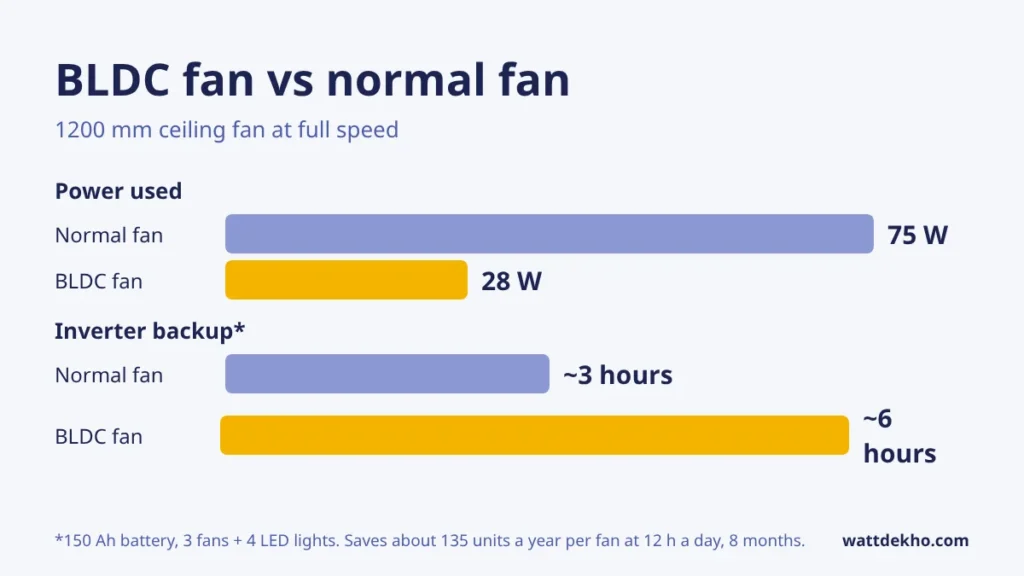
So the honest saving at full speed is around 40 to 47 W per fan. At speed 2 or 3 both fans draw less, so the gap shrinks. If your fan mostly runs at half speed, expect about half the savings shown below.
To see what all your appliances draw together, add them in the home load calculator.
How much a BLDC fan saves in a year
These figures compare a 75 W fan with a 28 W BLDC fan at full speed. Use the row that matches how your home actually uses the fan, and your own tariff from your bill.
| Use | Units saved a year | Saving at ₹7 a unit | Saving at ₹9 a unit |
|---|---|---|---|
| 8 hours a day, 8 months | 90 | ₹630 | ₹810 |
| 12 hours a day, 8 months | 135 | ₹950 | ₹1,220 |
| 12 hours a day, 11 months | 186 | ₹1,300 | ₹1,680 |
| 16 hours a day, 11 months | 248 | ₹1,740 | ₹2,230 |
If your bill crosses into a higher slab in summer, the last units you use cost the most, so the real saving is often higher than the average rate suggests. The electricity units calculator shows how watts and hours turn into units.
BLDC fan price in India in 2026
A 1200 mm BLDC ceiling fan from a known brand starts at about ₹2,500 online. Havells listed its cheapest 1200 mm BLDC model at ₹2,499 on Amazon in mid-2026. Most popular models sell for ₹3,500 to ₹4,500. Smart fans with voice control, underlights or designer bodies run from about ₹5,500 to ₹11,000, and that extra money buys looks and features, not lower watts.
Here is how five popular models under ₹4,000 compare. Service value is air delivery divided by watts, so a higher number means more air for each unit of power.
| Model (1200 mm unless noted) | Price | Watts | Air delivery | Service value |
|---|---|---|---|---|
| Bajaj Energon | ₹3,899 | 26 W | 215 m³/min | 8.3 |
| Crompton Energion Cromair | ₹3,899 | 28 W | 220 m³/min | 7.9 |
| Goldmedal Opus Prime | ₹3,879 | 30 W | 225 m³/min | 7.5 |
| Atomberg Renesa Enzel (1400 mm) | ₹3,799 | 35 W | 255 m³/min | 7.3 |
| Havells Ambrose Slim | ₹3,990 | 32 W | 225 m³/min | 7.0 |
All five use less than half the power of an old fan while moving similar air. For a fuller comparison with warranty and service, see our best BLDC fan guide.
Is a BLDC fan worth the extra price?
CEEW found in 2023 that the cheapest unrated induction fan sold for about ₹1,500. With BLDC models starting near ₹2,500 and most selling around ₹3,900, a plain BLDC ceiling fan usually costs ₹1,000 to ₹2,500 more than a basic fan of the same size.
| How the fan is used | Yearly saving at ₹7 | Payback on ₹1,100 extra | Payback on ₹2,500 extra |
|---|---|---|---|
| 8 hours a day, 8 months | ₹630 | About 1 year 9 months | About 4 years |
| 12 hours a day, 8 months | ₹950 | About 1 year 2 months | About 2 years 7 months |
| 16 hours a day, 11 months | ₹1,740 | About 8 months | About 1 year 5 months |
A BLDC fan is clearly worth it in the living room, a work-from-home room, a shop, or anywhere in south and coastal India where fans run most of the year. It is a weak buy for a guest room fan that runs a few weeks a year. And if your old fan works fine and is lightly used, replace it when it dies rather than now.
BLDC fans on an inverter during power cuts
This is where the BLDC fan pays off in comfort, not only money. Take a common home setup: a 150 Ah, 12 V battery, three ceiling fans and four 10 W LED lights running during a cut.
| Load during the cut | Total draw | Approximate backup |
|---|---|---|
| 3 normal fans + 4 LED lights | 265 W | About 3 hours |
| 3 BLDC fans + 4 LED lights | 124 W | About 6 hours |
Same battery, about double the backup. If you are planning to buy a bigger battery, switch to BLDC fans first and you may not need it. Try your own numbers in the inverter backup calculator, and if you are buying a new setup, read how to choose an inverter for home.
For homes with long cuts and no inverter, a rechargeable BLDC fan with its own battery is another option.
BLDC fans and rooftop solar
Every watt you remove from your load is a watt your solar system does not have to make. Five fans running 12 hours a day use about 2.8 units a day less as BLDC fans. One kilowatt of rooftop solar makes roughly 4 units a day in most of India, so that is about 0.7 kW less solar for the same bill.
If you run on batteries, the effect is bigger, because battery capacity is costly. See the solar battery guide before sizing one, and use the solar calculator with your bill after the switch, not before.
BLDC fan advantages and disadvantages
The advantages are clear from the numbers above:
- Less than half the power of a normal fan at full speed.
- About twice the backup on the same inverter battery.
- Runs cooler and quieter, with precise speed steps and a remote.
- Keeps steady speed even when the supply voltage is low.
The disadvantages matter just as much before you buy:
- No wall regulator. Brands tell you to remove the regulator or bypass it. Speed comes from the remote, so keep a spare cell and know the app.
- Electronics can fail. The driver board is the weak point when the supply has spikes. Check that the warranty covers the driver and that the brand has service in your town.
- Low watts do not always mean good air. Some cheap models save power by moving less air. Compare air delivery in m³/min on the BEE label, not only watts.
- Higher price upfront. Worth it on busy fans, not on every fan in the house.
- A short start delay. Many BLDC fans take a few seconds to start spinning. That is normal.
How to read the BEE star label on a BLDC fan
Star labelling became mandatory for ceiling fans in India from 1 January 2023. The label shows two numbers that matter: air delivery in cubic metres per minute, and service value, which is air delivery divided by watts. A higher service value means more air for each unit of power. Most 5-star fans on the market use BLDC motors.
When comparing two BLDC fans, look at air delivery first so you know the fan will cool the room, then service value, then price. A 1200 mm fan for a normal bedroom should have air delivery broadly in the range of a regular fan, around 200 to 230 m³/min.
BLDC fan: frequently asked questions
What is the BLDC full form in a BLDC fan?
BLDC stands for brushless direct current. A BLDC fan uses a motor with permanent magnets and an electronic driver instead of brushes or a capacitor-run induction winding.
What is the price of a BLDC fan in India?
A 1200 mm BLDC ceiling fan from a known brand starts at about ₹2,500, and most popular models cost ₹3,500 to ₹4,500 in 2026. Smart and designer models cost ₹5,500 to ₹11,000.
How many watts does a BLDC fan use?
Most BLDC ceiling fans use 26 to 35 W at full speed, compared with 70 to 75 W for an old induction fan. At lower speeds both use less.
Does a BLDC fan really save electricity?
Yes. Running 12 hours a day for eight months, a BLDC fan saves about 135 units a year over a 75 W fan, roughly ₹950 at ₹7 a unit. The saving falls if the fan mostly runs at low speed.
Is a BLDC fan better than a normal fan?
For a fan that runs most of the day, yes: it uses less than half the power, runs cooler and quieter, and doubles inverter backup. For a fan used rarely, the extra price takes too long to recover.
Can I use a BLDC fan with a normal regulator?
No. Brands advise removing or bypassing the wall regulator, because it can damage the driver. Use the remote or app to change speed.
Does a BLDC fan work on an inverter?
Yes, on a normal home inverter. Because it draws less power, the same battery lasts about twice as long with BLDC fans as with normal fans.
Can a BLDC ceiling fan run directly on a solar panel?
Not a regular one. Standard BLDC ceiling fans run on 230 V AC from your wiring. Only special 12 V or 24 V DC fans can connect to a solar panel and battery directly.